PC
Poker and deckbuilders seem natural bedfellows, and that’s before Balatro came along and proved it by making everyone go mad for it. Devil’s Due aims to join in the fun by offering something everyone probably secretly wishes they had when playing poker: a way to cheat. Who wouldn’t want to be able to secretly change a card into the one that completes the straight they were going for, take a peek at the deck to see whether they’ll hit that flush, or store the fabled ace of spades up their sleeve for the perfect occasion?
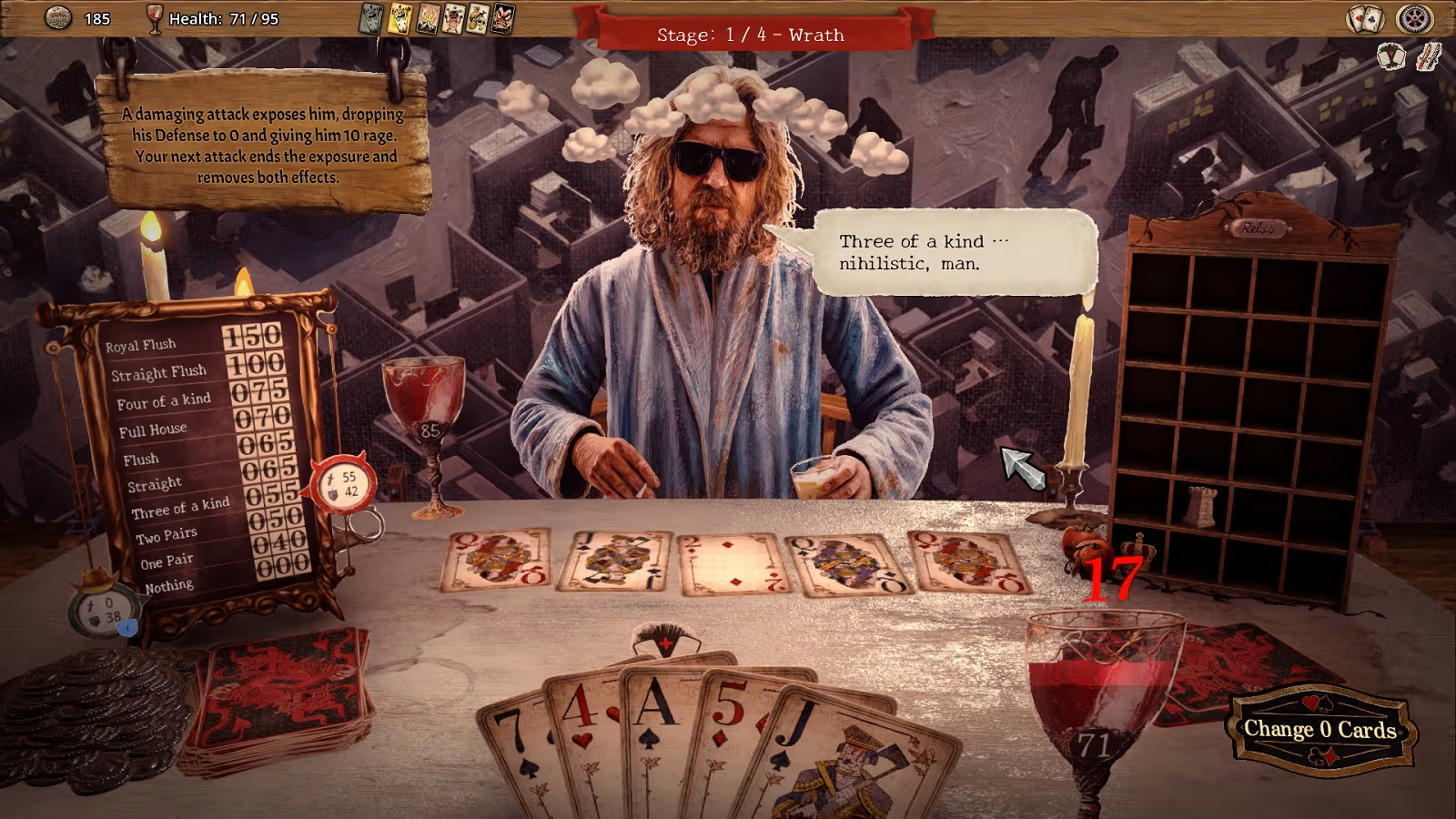
Devil’s Due casts you as Jack, a cowboy happily playing poker until he’s interrupted by the Devil himself. The Devil challenges him to a game, offering treasure in exchange for Jack’s soul. The Devil wins, I assume by cheating - this is the Devil, after all - and sends Jack to Hell. Jack decides the game hasn’t finished (I’d say it has!) and that he can cheat too, and so the stage is set for Jack to play a load of demons at poker and win his way out of Hell.
The Devil not only agrees to this – which is strange, because he’s already won – but also offers Jack some relics to help him cheat. He provides rest stops and shops where Jack can buy more things to help him escape, too. Not as bad as we’re led to believe, this Devil. Maybe he’s just misunderstood. You don’t know him like I do.
The mechanics are based on a simplified version of five-card draw, rather than Texas hold’em, which has become the better-known and more popular form of poker. You are dealt five cards, get a single opportunity to replace as many of them as you like, and then play your hand. Because it is a deckbuilder, and not actually poker, you have hit points rather than chips. Your offence score is based on your hand, with a pair, straight, flush and so on dealing increasing amounts of damage according to how difficult they are to achieve. Your defence score, meanwhile, is the sum of the values of the cards in your hand. Each player therefore takes damage based on their opponent’s hand score, minus the value of their own cards.
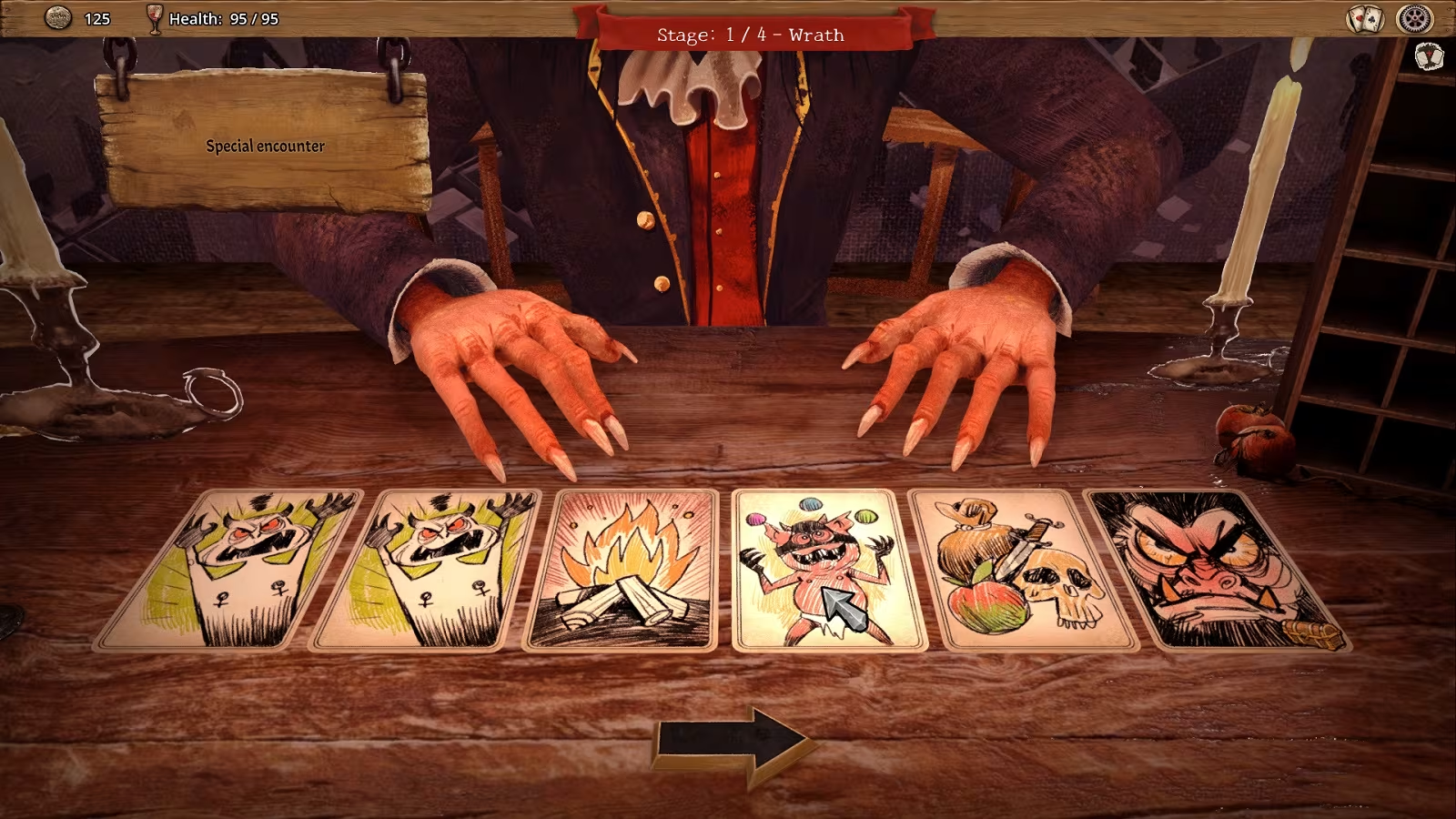
This being Hell, and the selling point of the game, you also have ways to cheat, in order to improve your hand beyond that single exchange of cards. You start with the ability to increase the value of any card in your hand by one. For example, if you have a King and an Ace, you can add one to the King and, hey presto, you have a pair of Aces.
In theory, you can do this as often as you like, until you have five Aces. The reason you can’t is that your opponent’s suspicion increases every time you cheat. Your opponent has a number of white clouds above their head. Every time you cheat, one turns black. When they’re all black, your opponent launches what’s called an Expose attack, dealing significant damage to your HP. Many opponents also have different mechanics based on your cheating activity, building rage, restoring HP, and so on, which all bring different downsides to these underhand tactics, so your strategy involves working out how often to cheat, bringing maximum advantage for minimum penalty.
There are various levels to attempt, each with different numbers of acts, starting cheat abilities and opponents. The acts are based on the deadly sins, and comprise a series of five or six battles, events, shops, rest sites… the usual deckbuilder array. There are some nice thematic touches, too. The shops, for example, are staffed by little devils (are those imps?) and will seemingly let you buy relics even if you can’t quite afford them. You can also move a card to rearrange the order of the act’s events to suit your preference. This is Hell, after all, and the sense that everyone is out to cheat each other works both ways. It’s a nice touch.
Events let you gradually adjust the shared deck, whereby you can remove cards from the deck, change a card’s suit, or splice cards together (allowing you to rotate it when drawn to whichever card suits you best). The deck is shared though, which seems a little confusing as to whether you are helping yourself or your opponent.
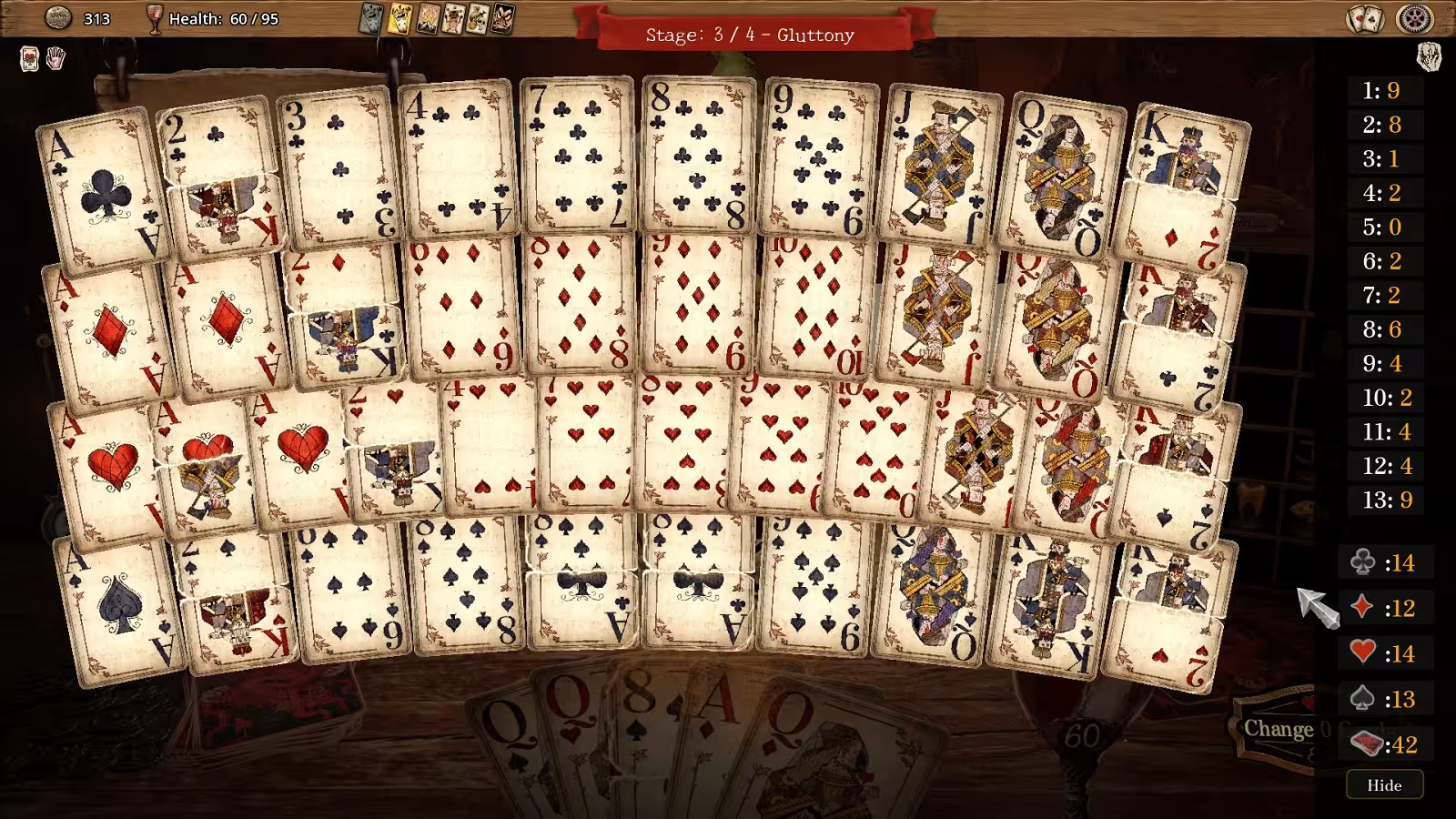
Your opponents are fascinating. It must have been a lot of fun to design these, with the theme of them being devils. The game's style seems inspired by Terry Gilliam's nightmarish cutout animations for Monty Python, and the developers have gone to town. You’ll encounter versions of Mr Creosote and The Dude from The Big Lebowski (El Deaderino), each with clever mechanical differences. Mr Creosote, for example, will explode after a certain number of rounds. They also have their own characters, such as an English tea-drinking fair play fanatic whose rage builds the more you cheat, or my own personal favourite, the Dad of the Year, who you can’t actually see, as he sits behind a huge newspaper instead of spending time with you, and says things like “Look who’s shown up just as I finally get some time to myself.” Ouch! There’s a lot of creativity here, and some really dark humour. The mechanics change from character to character in ways that suit their designs and make each fight meaningfully different.
Each character will have their own intro line, with Jack having his own smug response, and this never changes, so begins to pall a little over time. And that can kind of go for the game as a whole, to be honest (though being honest feels somewhat opposed to the point of the game). The initial pull of cheating, which is really the main draw (blimey, too soon for another pun) for the game, doesn’t quite live up to the promise. I said earlier on that we all want to cheat at poker.
Well, the problem here is that this isn’t cheating, in the real sense of the word, and it isn’t poker.
Cheating needs that sense of “will I get away with it?”, and that’s missing here. Either there are enough white clouds over your opponent’s head, in which case you’ll get away with it, or there aren’t, in which case you won’t. The mechanics change depending on your opponent, but they’re strict and behave appropriately, and so cheating becomes an entirely consistent and understood mechanic, which isn’t really cheating. I understand why the developers have done it this way. Making cheating feel more authentic – where you might get caught, or might get away with it – would make it less reliable from a game-design point of view. But that uncertainty is the thrill of cheating. Without that uncertainty, cheating just makes the single opportunity to change cards slightly less restrictive.
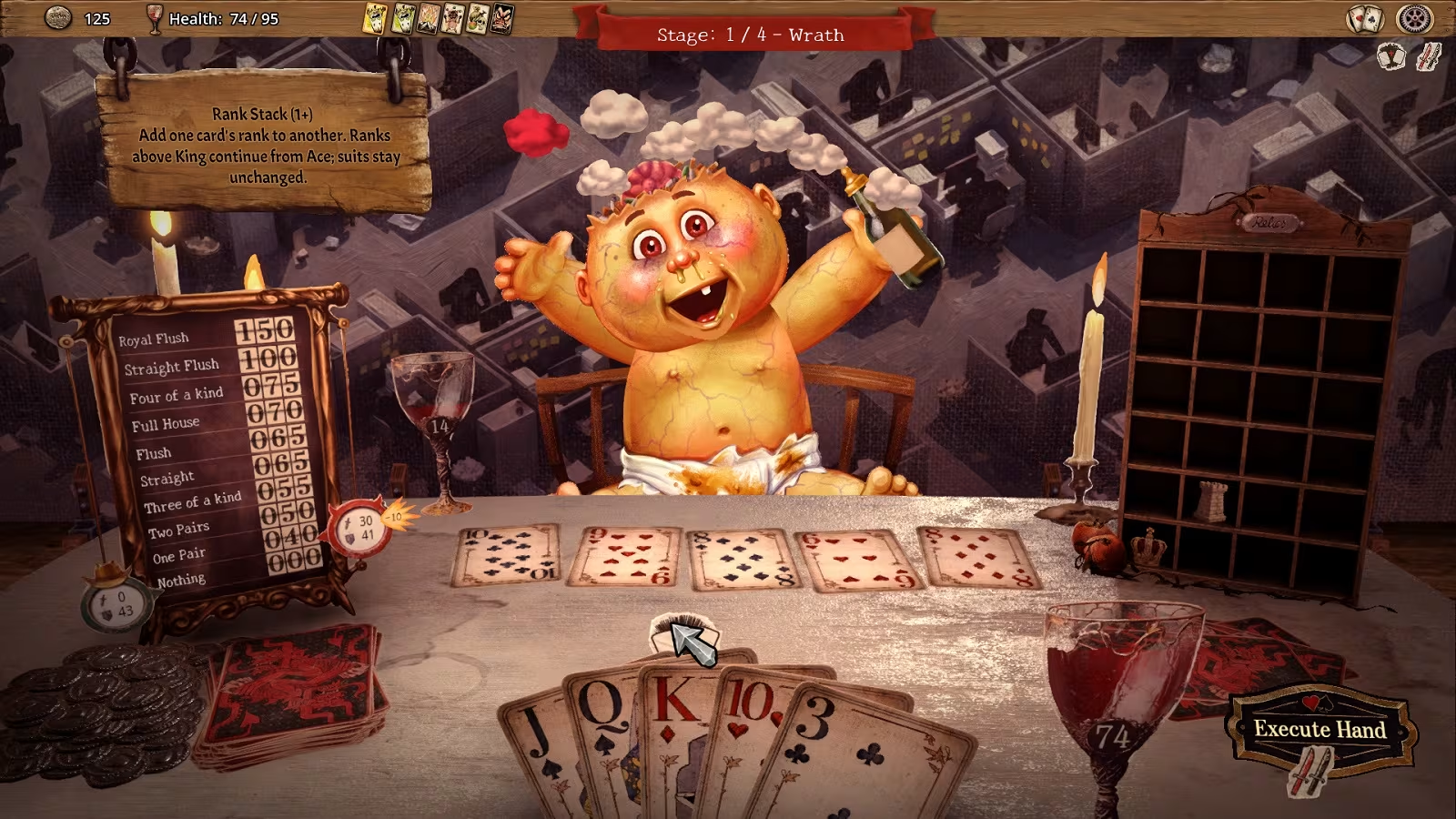
If the ratio of white/black clouds changed the ratio of your opponent watching their cards as opposed to watching you, and you had to find the right moment to cheat, that might make that more of a feeling of “will I get away with this or not?” but as it is, it’s just as much a mechanic as changing cards, which feels a missed opportunity.
And it isn’t really poker, which matters, too. The game does away with some of the best bits of poker: the thrill of hitting the card you need, the gambling strategies, the chip stacks and so on.It’s a straightforward one-swap affair, which becomes rather dull when you get down to it. Giving the player one or two extra ways to make it more interesting doesn't change that enough. Because each run through only has one or two ways to cheat at a time, you don’t get to choose which one might help you at that time. You get your cards, change your cards, and can apply your current cheating method or not. That’s pretty much it.
Compared with the strategic options offered by other deckbuilders, this feels slight and repetitive. Cheating isn't really anything more than an extra action in place of another opportunity to swap cards.
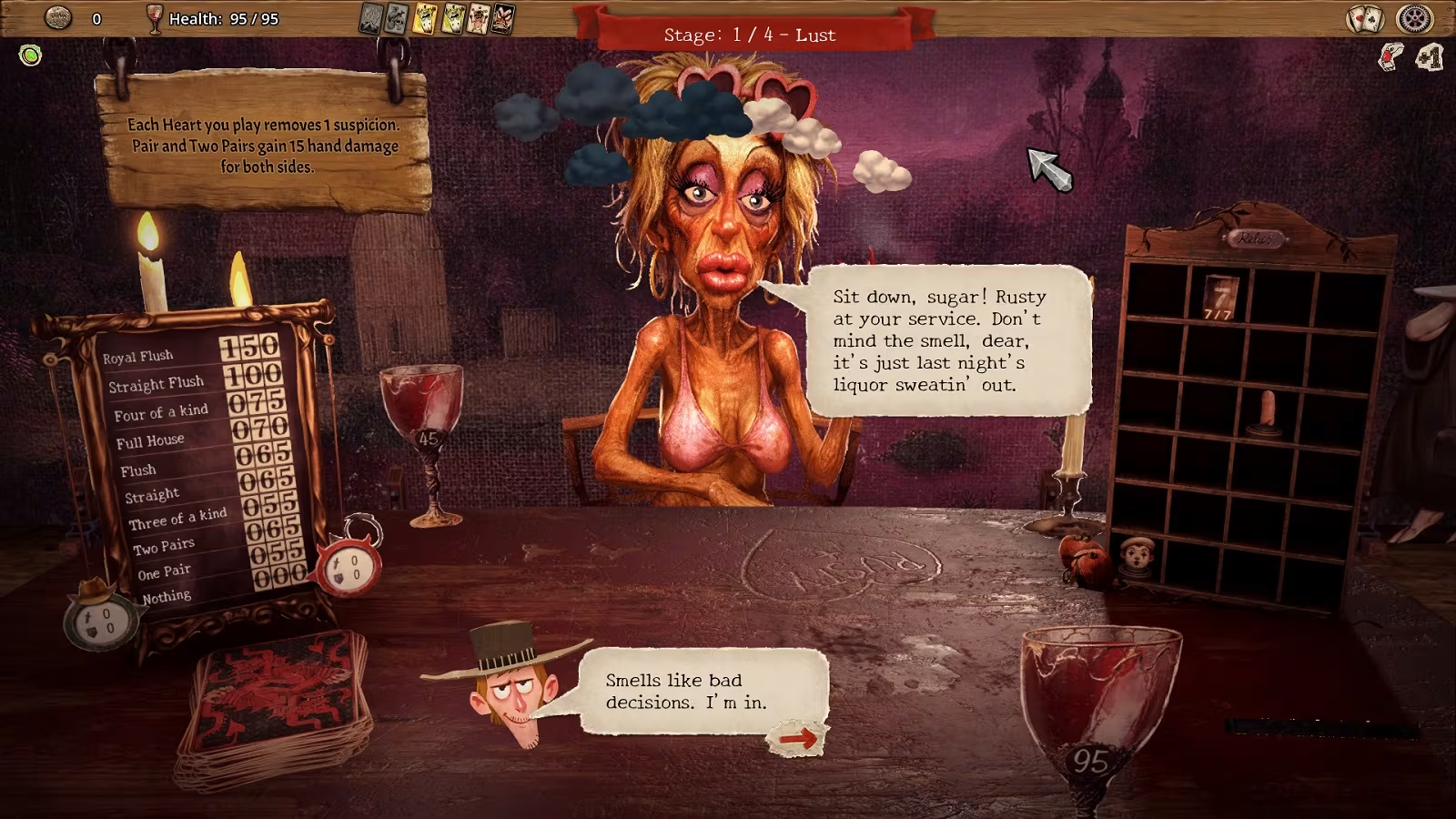
Some of the more mathematical explanations of the mechanics can make you pause. “Attacks that don’t lower his HP give him 5 rage. Attacks that do give him 15 HP minus his rage” can take a few re-reads to take in an opponent’s core mechanic. It feels a little clumsy in a way that the best deckbuilders usually avoid, making you do your own accounting rather than immediately understanding the result of your actions.
Ultimately, Devil’s Due is more fun when it lets you enjoy its strange cast of characters and the increasingly elaborate ways they try to get one over on you. It just never quite delivers the thrill of getting away with something yourself. For a game about cheating, that's a surprisingly big missed trick.
You can subscribe to Jump Chat Roll on your favourite podcast players including:
Let us know in the comments if you enjoyed this podcast, and if there are any topics you'd like to hear us tackle in future episodes!