
Evaluating one of the many available audio headsets available within the current gaming world demands that I look past marketing buzzwords and all the puffery (N.B. actual marketing term), with a view to actually working out whether the unit is good at what it needs to be good at. There are so many around and they all say incredible this; wicked that – but which are good and of those, are any better than others?

Well, with the introduction of the SteelSeries Arctis Nova 7X Wireless Gen 2 headset, the Danish peripheral manufacturer is not issuing an iterative update to existing hardware; they are attempting to lock down the ultra-competitive £179.99 mid-range category by migrating capabilities previously reserved for their top-tier luxury lines into a lower-tier, i.e. cheaper, product. Achieving this requires a careful balance of product design, material science, and sound engineering. And although the marketing tells me they’ve achieved it, the actual experience does, too.
Physical Design and Mechanical Ergonomics
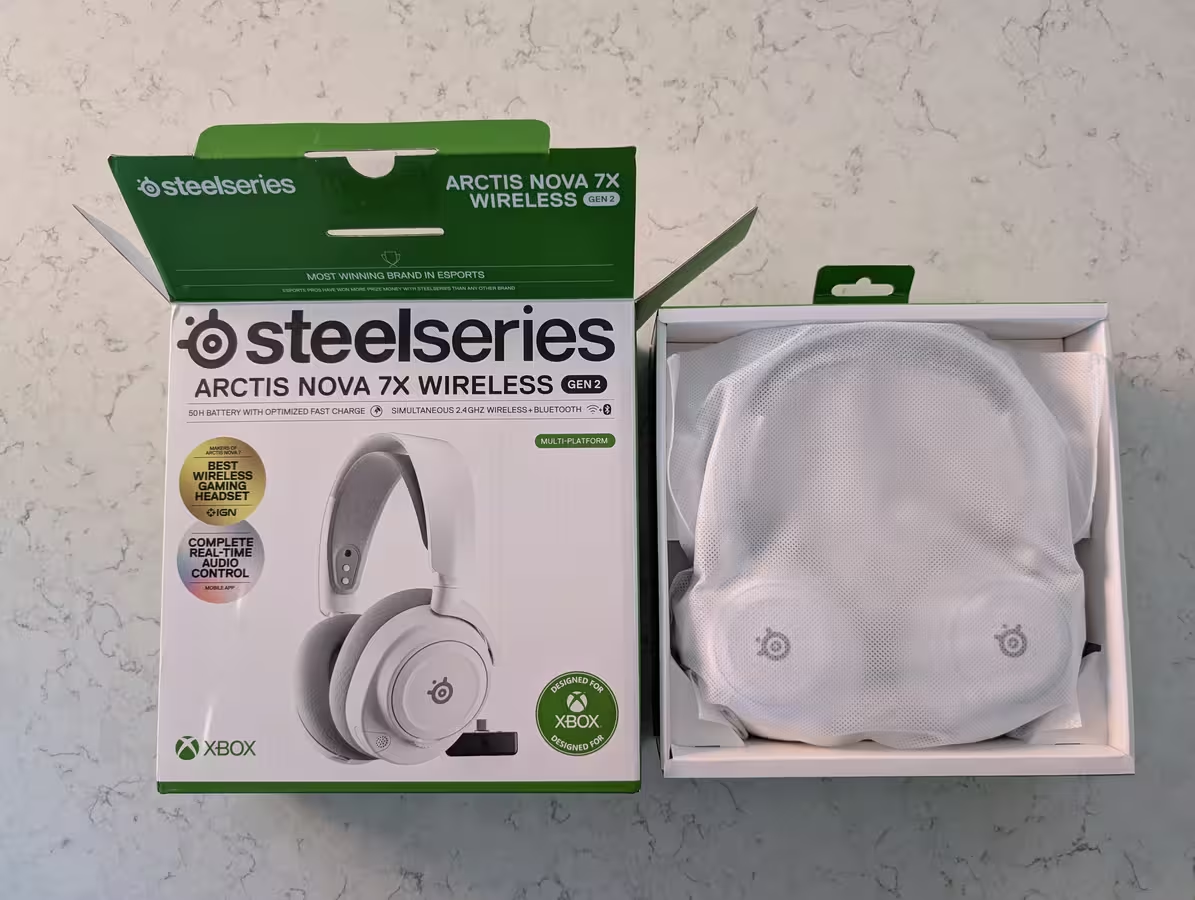
First impressions upon unboxing the Arctis Nova 7X Gen 2 are strong. SteelSeries has prioritised a clean, minimalist silhouette that sits comfortably on a living room shelf or a dedicated media unit without screaming its identity as a video game peripheral. It comfortably looks like something Apple, or BOSE, could have produced. It is an understated design language that prioritises functional elegance over big brash branding, an approach which I can actively get behind when leaving the headset in the living room where my wife and kids can see it.
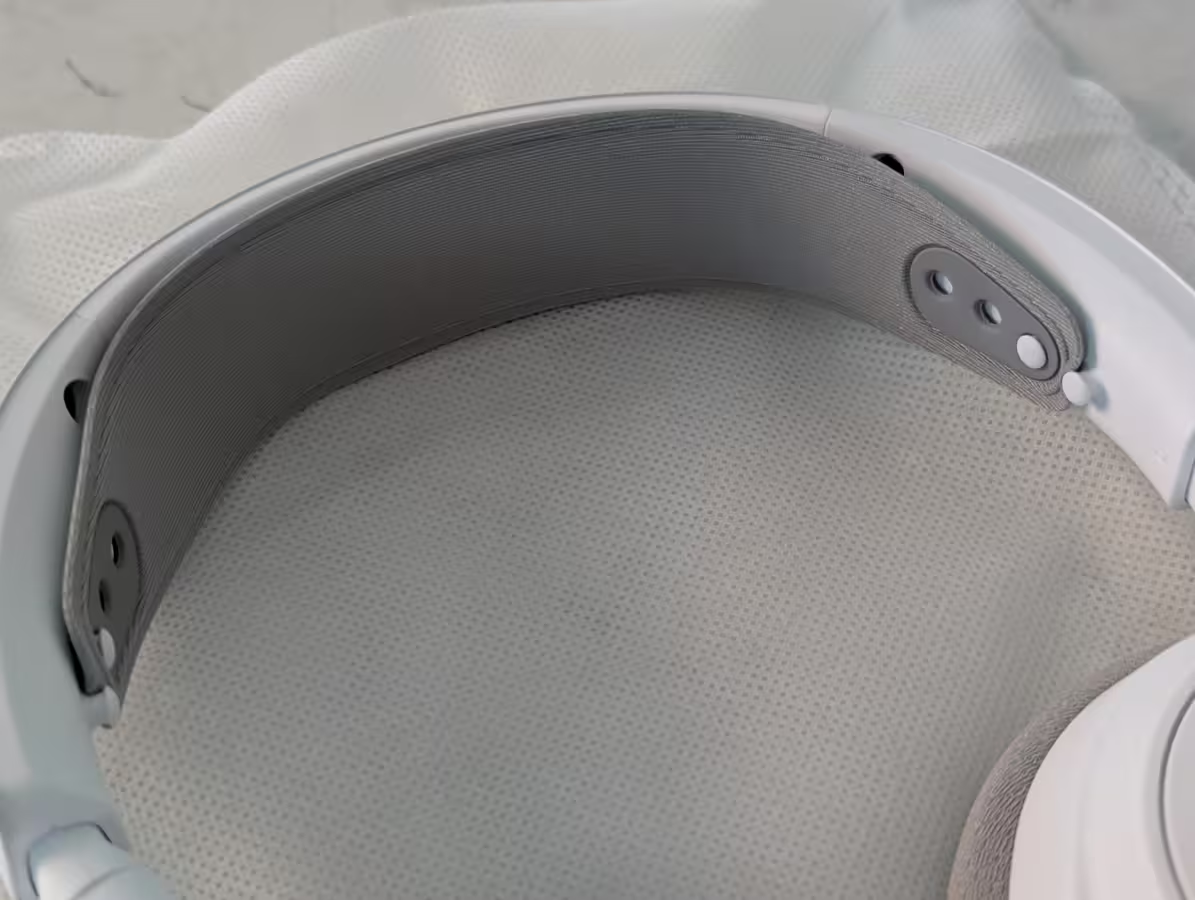
The foundation of the chassis relies on a dual-component headband. The primary structural load is borne by a stiff, PVD-coated steel outer band, which ensures long-term stability and integrity under repeated use - meaning it should last through multiple cycles of putting it on and taking it off. Suspended directly beneath this metallic frame is an adjustable, elasticated inner comfort band– reminiscent of ski goggle suspensions – crafted from a durable textile featuring three separate button-clipped tension positions. This configuration ensures all the 326g weight and stress of wearing the unit is distributed evenly across the skull of its wearer. Which is to say that the fit can be altered to provide maximum comfort and I’d expect everyone to find it fits them well for short and long periods of gaming.
The cans move up and down into and out of the headband, with four different settings. The ear cups themselves exhibit a comprehensive degree of articulation, sliding up and down to accommodate differing shapes and sizes of heads, and twisting along the horizontal axis to sit over anyone’s ears when using them. This also allows us to rest the headphones around the neck with the cups flat against the chestbone.

However, this high degree of freedom introduces a distinct mechanical quirk during daily handling that I found immediately noticeable. In my house, my media setup sits alongside the PlayStation 5 on a dedicated console unit. Every single time I reach down to pick up the Arctis, my muscle memory betrays me. Because my main headset since the PS5 launch has been Sony’s Pulse 3D, I am deeply accustomed to a rigid, fixed, unit. When I grab the Pulse by one ear cup, I lift the entire thing. If I attempt that maneuver with the Arctis Nova 7X Gen 2, the extraordinarily low-friction horizontal swivel causes the ear cup to instantly spin and twist under the weight of the steel headband. The whole thing moves rapidly in my hand, meaning I completely lose my grip on the rest of the unit unless I use both hands or consciously adjust my lift point (which is tough to do regardless given the headset sits on a shelf). It is a minor point, admittedly, and one that will fade as my muscle memory adapts to this new set of headphones, but it represents a clear mechanical trade-off where horizontal articulation has been prioritised over handling rigidity, and is an issue for me, so might well be for some of you.
Where the product design triumphs absolutely is in its choice of materials. The ear cushions are upholstered not in standard polyurethane faux leather, which inevitably acts as a thermal insulator and moisture trap, but in a proprietary AirWeave textured mesh fabric. This choice of porous fabric means the cups stay cool and dry. Tested rigorously during the summer 2026 UK heatwaves – where ambient indoor temperatures in Buckinghamshire frequently soared past 30°C and peaked toward the mid-30s – the thermal comfort was exemplary. The fabric maintained breathability without inducing sweating or sliding across the head in any way. The interior size of the cups provides comfortable clearance for the ear, avoiding squashing and hurting the cartilage, even during extended four-to-five-hour operational sessions.
Wireless Connectivity, Architecture, and Mobile Software Integration
The Arctis Nova 7X Gen 2 has a rather fancy dual- wireless setup, designed around a compact, low-latency USB-C dongle and Bluetooth. The form factor of the dongle is deliberately sized to keep adjacent inputs accessible on next-generation consoles like the PlayStation 5 and Xbox Series X. Operating on a low-latency 2.4GHz RF band alongside the separate Bluetooth 5.3 controller, the device handles simultaneous, mixable audio streams (a maximum of one wireless and one Bluetooth) with ease.

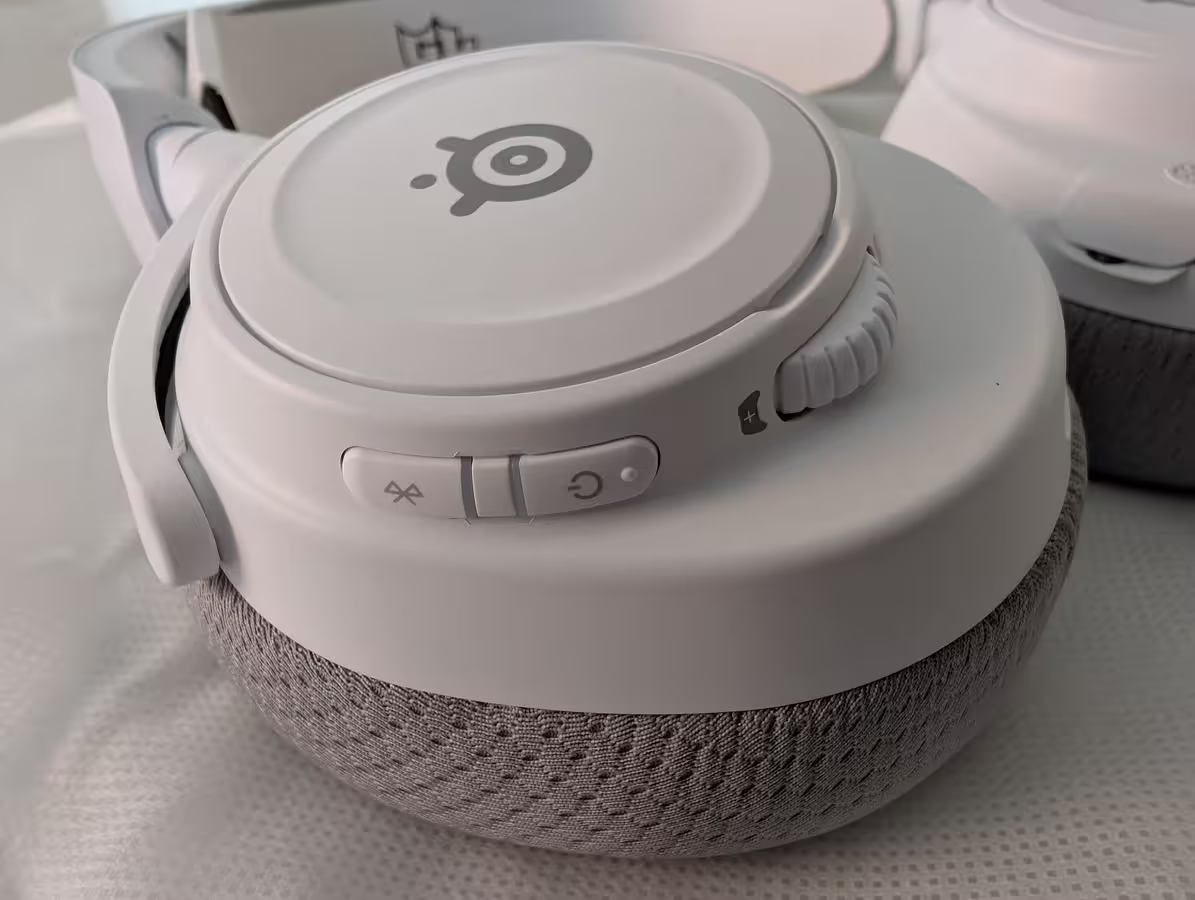
Managing these dual streams represents a departure from traditional single-button power states. The headset treats its 2.4GHz RF and Bluetooth systems as two discrete, parallel on-off switches. Activating the main power button establishes an instantaneous handshake with the USB-C receiver. To bring mobile or secondary audio into the matrix, I had to explicitly engage the secondary Bluetooth button. This provides total control over what you connect to and when you do it, but it took me a while to get to grips with rather than just turning something on and off. Simple is good.
Bluetooth is strictly limited to a single active connection at any given time. While the unit can store multiple pairing profiles in its memory, it will automatically connect to the most recently paired device upon boot. If you want to switch the Bluetooth stream from a smartphone to a Google 4K TV Streamer, as I wanted to do for example, the headset will not automatically yield the connection based on which device is actively playing audio. Instead, you need to manually disconnect the unit within the smartphone's settings before it can be successfully claimed by the secondary Bluetooth source, and vice-versa. It does not automatically jump frequencies; it holds tightly to its active pairing. This is a good thing when in use, but a little frustrating for me when I started using it and had to fiddle about to get the right connections set up.
The true competitive advantage of this simultaneous dual-wireless setup is realised through the mobile Arctis Companion App. By pairing the headset via Bluetooth to a smartphone while it remains connected to a console via the 2.4GHz dongle, the user gains real-time, on-the-fly equalization control over the console audio without needing to leave the game environment or switch on a PC. For console players on Xbox or PlayStation, who historically have been restricted to basic, flat graphic equalizers or completely unalterable sound signatures, this is a monumental leap in utility. It’s very easy to change, too, using the companion app.
The app provides instant access to over 200 pro-grade audio preset profiles tailored to specific games by sound designers and esports practitioners. In fast-paced competitive environments like Call of Duty, swapping to the "FPS Footsteps" profile dynamically suppresses muddy mid-bass reflections from explosions while emphasising the sharp spikes associated with footsteps or weapon reloads.
Beyond the benefits when competing against others, the simultaneous mixing capability supports a well-balanced lifestyle too. This became incredibly useful during my testing with NBA THE RUN. Playing on my own without friends in the party chat, I had absolutely no desire to listen to the repetitive in-game soundtrack or the commentary track. By firing up the Arctis App, I was able to route Spotify directly from my phone via Bluetooth while simultaneously maintaining the game feed from the PS5. The on-ear controls include a dedicated tactile wheel to manage ChatMix, which allowed me to dim the arena sounds while boosting my personal playlist. It is a flawless execution that quickly became one of my favourite things about this headset. It’s a simple idea, executed flawlessly and to that I say “bravo!”.
Sound Performance
At the core of the speakers are custom-designed Neodymium Magnetic Speaker Drivers. Neodymium magnets possess exceptionally high magnetic flux density (they are strong magnets) and coercivity (not going to lose its magnetic property anytime soon). This ensures an incredibly detailed soundstage characterised by razor-sharp clarity across the entire audio spectrum.
The defining characteristic of the sound in my mind is its absolute transparency. In testing across both films and games, the headset revealed low-level sounds that I didn’t remember hearing before. This transparency was tested using my go-to benchmarking scene: the lobby sequence from The Matrix on Blu-ray. Before the chaos of the gunfire began, the detailed reproduction was startling. The mechanical click of the lift buttons, the sliding resonance of the security gate rails, and the subtle ambient reflections of footsteps against the marble floor were reproduced accurately and with the right spatial positioning. The headset exposed the underlying layers of the Wachowski’s sound mix, delivering atmospheric cues that have been present in the audio track for over two decades but that I had not heard before. This might be a little hyperbolic; but compared to the soundbars and headsets I’ve had in the 27 years since the film’s release, this clarity and detail was a big wow.
When a soundtrack demands bass, the reproduction here was deeply authoritative. This was not the loose, unmanaged acoustic boom common in mass-market headsets that give something a little fake. Instead, the low-frequency response was physically impactful. During a screening of the Chinese science-fiction film The Wandering Earth via the Google 4K Streamer, the low-frequency rumble of earthquakes and shifting tectonic plates was rendered with literal, physical vibration. I felt the sheer energy of the air displacement within the cup directly against my head, providing an immersive and visceral haptic sensation that is rare in my experience with budget or mid-ranged headsets. The headphones were able to switch from quiet, high-pitched mechanical clicks to massive, low-frequency planetary rumbles without demonstrating any audible distortion or confusing sound. It really enhanced my viewing experience.
Minor Structural and Acoustic Failings
Despite its overwhelming technical triumphs, the Arctis Nova 7X Gen 2 is not entirely free from imperfections. The first and most notable issue is a prominent, persistent background noise floor - an audible hiss that is present whenever the audio hardware is active but no signal is being sent from the source. This minor hum is common in wireless sound circuits, exacerbated here by the proximity of dual active wireless transceivers and the high sensitivity of the drivers. Thankfully, this hiss disappeared completely the exact millisecond an audio stream commenced; it did not degrade the signal-to-noise ratio during gameplay or media playback, nor did it muddy the clarity of anything. However, when sitting in quiet menus or waiting in loading lobbies where the audio completely dropped out, the presence of this static hiss was a minor but persistent irritation.
The second problem concerns sounds not from the headset when wearing it. Any physical contact with the exterior frame – such as brushing the PVD-coated steel headband, adjusting a pair of glasses, or moving the head rapidly – created an unnaturally loud, resonant mechanical conduction directly into the ear cups. It was very annoying, at first. I did get used to this a little bit, and it’s not a killer issue but it isn’t nice either.
Crucially, however, this build configuration does offer an unexpected quality-of-life benefit. Unlike heavily insulated active noise-cancelling (ANC) earbuds or tightly sealed leather cans, you do not actually have to tear the headset off to hold a brief conversation. As long as you pause your active media stream, you can converse clearly with someone stepping into the room through the fabric mesh ear cups. It is a practical touch that mitigates some of the isolation issues inherent to gaming gear.
Battery Lifespan and Power Management
Power management has received a significant engineering overhaul, representing a 40% increase in capacity over the first-generation Arctis Nova 7. The lithium-ion internal battery delivers a verified lifespan of up to 54 hours of continuous playback over a low-latency 2.4GHz connection. In real-world multiplatform testing across a fortnight of heavy daily use incorporating mixed console gaming sessions and late-night film streaming, the battery comfortably cleared the ten-day mark before requiring mechanical recharging.

The physical hardware features a reliable, tri-colour LED power indicator situated directly on the chassis. The LED transitions through green, amber, and red states to provide an instant visual read on the remaining state of charge. This onboard diagnostic completely removes the frustration of needing to navigate through console dashboard menus or mobiles just to check power levels.
When the battery is finally depleted, the charging interface utilises highly optimised USB-C fast charging. Connecting the unit via a high-current USB-C delivery rail gives up to 6 hours of continuous operational playback from a 15-minute charge cycle.
Comparative Market Position and Final Verdict
It makes sense to compare and contrast the Arctis Nova 7X Wireless Gen 2 against its nearest market competitors within the £150 to £200 mid-range price bracket. The following table isolates some key metrics across the current mid-range landscape:

Looking at this chart, the advantages of the Nova 7X Gen 2 become distinct. While the PlayStation Pulse Elite offers planar magnetic drivers at a lower price point, its physical build is comparatively fragile, its battery life is nearly half that of the Nova 7 Gen 2, and it lacks real-time mobile app equalization profiles. Conversely, while the Turtle Beach Stealth 700 Gen 3 boasts a larger battery, it does so at the cost of a massive 408g that compromises long-term comfort. At 326 grams, the Nova 7X Gen 2 remains the lightweight, structurally superior option for multi-hour sessions.
The integration of the mobile Arctis Companion App cements the unit’s position as the definitive mid-range solution for console and multiplatform players. The ability to seamlessly execute simultaneous mixable audio over low-latency 2.4GHz and Bluetooth – while retaining full control over the sound in real time – elevates the headset far beyond the standard of this category. Minor faults like the idle noise floor are real setbacks, but they do not impinge upon what is otherwise an absolute triumph. For those looking to secure a master class in dual-audio multitasking, durability, and clarity under £180, the Arctis Nova 7X Wireless Gen 2 is an essential, highly recommended purchase for any serious gaming setup.
You can subscribe to Jump Chat Roll on your favourite podcast players including:
Let us know in the comments if you enjoyed this podcast, and if there are any topics you'd like to hear us tackle in future episodes!